
This year's contest was slightly larger than last year with a total of 76 contestants. It was amazing to sit back and listen to all the great music, and to hear how everyone has improved since last year!
We started everything off with the Junior Flattop Guitar Contest. There were so many contestants in this division that we actually ended up splitting the division into two divisions. It was originally 16 & Under, but we went ahead and judged 10 & Under in its own division. Here are the results:
Flattop Guitar - 10 & Under
1st - Claire Rausch
2nd - Emily Causey
3rd - Isabelle Hobbs
4th - Katie Haubrick (Most Entertaining)
5th - Noah Lintker
Youngest - Isabella Worthington
Flattop Guitar - 16 & Under
1st - Rosemary Hall (3rd year in a row!)
2nd - Sam Currey
3rd - Matthew Worthington
4th - Colin Gray
5th - Amber Bleem
After the Youth Guitar divisions, we had the Open Guitar division. This was for ages 17 & Up. Ages of contestants in this division ranged from 17 to 74 years of age, and since the oldest and the youngest both placed, this just goes to prove my theory that you are never too old or too young to play music!
Flattop Guitar - Open Division
1st - Zane Prosser (Oldest Contestant)
2nd - Emily Hall (Most Entertaining)
3rd - Chelsea Bergmann
4th - Mike Wall
5th - Dan Fraser
One of the unique things about our October contest is that we have an Adult Beginner Division for both the fiddle and the banjo. This division is specifically for anyone that is 21 years of age or older, and has played for four years or less. It's a great way for adults to ease into playing in front of other people. The purpose is to get everyone used to playing in front of others as soon as possible, but also allow them to do it without having to follow a veteran player. The banjo players only play one song in this division, but the fiddle players still have to do a waltz and a hoedown. I think this year's Adult Competitions were some of the best we've ever had.
Adult Beginner Fiddle
1st - Denise Voegele
2nd - Trice Pisetta
3rd - Kevin Martin (Most Entertaining)
4th - Zach Bergmann
5th - Lena McDonnell
Adult Beginner Banjo
1st - Dennis Huebner
2nd - Steve Dibbert (Most Entertaining)
Next stop is the Junior Fiddle divisions. We had a total of 23 contestants in two divisions! This division was very entertaining because there were so many great performances by the cutest fiddlers I've ever seen. I could write a paragraph about each one! It is a testament to the parents that they help their kids make time for this, and then support them in it. I would like to make special mention of our 3rd place winner, Lillie. Lillie is not a Bluegrass Shack student, and she played all by herself because she is new to bluegrass and had not played with a guitar player before. She did an amazing job and has such a great tone quality.
Junior II Fiddle (12 & Under)
1st - Audrey Neel (Most Entertaining)
2nd - Nathanael Worthington
3rd - Lillie Roever
4th - Maggie Currey
5th - Nolan Neumeyer
Youngest - Isabella Worthington
Junior I Fiddle (13 - 17 Years Old)
1st - Rosemary Hall
2nd - Emily Hall
3rd - Emily Morgan (Most Entertaining)
4th - Caroline Stewart
5th - Lucas Worthington
The Open and Senior divisions of the fiddle competition were fierce! Though it was all in fun, these contestants were really out to beat each other! They were even trying to guess who was the oldest at the awards ceremony (and they were wrong). This was certainly a lot of fun.
Open Fiddle
1st - Chelsea Bergmann
2nd - Dennis Huebner
3rd - Katarina Worthington (1st contest)
4th - Tim Dever
5th - Susan Crider (Most Entertaining)
Senior Fiddle
1st - Ron Dailey
2nd - Zane Prosser
3rd - Pat Sorrell (Oldest Fiddle Player)
4th - Bill Weiss
Now, last but certainly not least, let's get on with the banjo competitions. We had eight contestants in the Junior Banjo division, which makes it one of the largest we've had. We certainly heard some fast picking!
Junior Banjo (16 & Under)
1st - Lucas Worthington
2nd - Luke Currey (Most Entertaining)
3rd - Jake Morgan
4th - Christi Gray
5th - Joshua Dolan
Youngest - Joy Ann Worthington
Open / Senior Banjo
1st Place Senior - Larry Maxwell (Oldest Banjo Player)
1st Place Open - Emily Hall
2nd Place - Chelsea Bergmann (Most Entertaining)
3rd Place - Kevin Martin
4th Place - Larry Reuss
A big thank you goes out to Dual Generation for making the food and taking care of everything that had to do with the food, including the setup, selling and cleanup. It was great. I had chili and chocolate chip cookies, so I know! G'Pops brought kettle corn as well, and I simply couldn't leave without buying a big bag for myself! With the holiday season approaching, if you are wondering what to get the person who has everything, you need to consider contacting G'Pops for a large holiday bag! I don't believe they do mail order, but if you are local, it's a great option. You can reach them at their website at http://www.gpopskettlecorn.com/.
Thank you to our judges, Iggie Tiemann and John Bell. They sat behind a curtain and judged for five hours! They are both great players, experienced judges, and simply wonderful people. My mom (Carla) took care of registration and scores, and Dennis and Steve helped at the door. Earl took pictures of every single contestant for us, which you can find on our Facebook page. We had lots of help setting up and tearing down, which is especially nice when there is so much to do. The audience was terrific -- very attentive and appreciative! This was a fun day and a huge success. Can't wait for the next one!
Sunday, October 28, 2012


Friday, October 19, 2012
Kid's Instructional Jam Group
This year, I started a youth instructional jam group. Previously, I had always encouraged kids to join us in the Monday night instructional jams, but they never kept coming. I decided this summer to give them their own jam group. It has worked out really well! We had about 12 kids coming regularly in the summer, and now that school is in sessions, more than half have decided to stay with the group.
This group meets every other week, and practices to perform at local venues such as nursing homes, churches and other events as requested. I am not personally involved in many of these outings. I leave it up to the parents to decide if they want to pursue most of the requests, which they have. Since July, they have played at the New Athens Home for the Aged, several different school functions in Waterloo and here in New Athens, churches, and bluegrass festivals, including the Ripson Bridge Festival. The group plays entirely for fun and does not make any money from any of their outings. The idea is that they should enjoy playing music and should enjoy sharing their music. They are free to come and go. Each student learns how to play the bass, and many play more than one instrument. They all practice different lead and harmony parts, and if one person can't make a gig, another one fills in the gap.
From a musical standpoint, they are learning how to create setlists, tell jokes, share the microphones, sing lead and harmony, play backup and take breaks, prepare for a gig, interact with folks at the gigs, set up equipment, and more! One of the most heartfelt moments for me was watching them talk to all of the residents at the New Athens Home for the Aged after they had finished their set. Every one of them spent time holding hands, hugging, and talking to the folks they had just played for. The joy that the music alone brought to these people was wonderful, but this was the icing on the cake in my opinion!
To have a talent is a wonderful thing, but to share that talent is a blessing to both the musician and the listener!
This group meets every other week, and practices to perform at local venues such as nursing homes, churches and other events as requested. I am not personally involved in many of these outings. I leave it up to the parents to decide if they want to pursue most of the requests, which they have. Since July, they have played at the New Athens Home for the Aged, several different school functions in Waterloo and here in New Athens, churches, and bluegrass festivals, including the Ripson Bridge Festival. The group plays entirely for fun and does not make any money from any of their outings. The idea is that they should enjoy playing music and should enjoy sharing their music. They are free to come and go. Each student learns how to play the bass, and many play more than one instrument. They all practice different lead and harmony parts, and if one person can't make a gig, another one fills in the gap.
From a musical standpoint, they are learning how to create setlists, tell jokes, share the microphones, sing lead and harmony, play backup and take breaks, prepare for a gig, interact with folks at the gigs, set up equipment, and more! One of the most heartfelt moments for me was watching them talk to all of the residents at the New Athens Home for the Aged after they had finished their set. Every one of them spent time holding hands, hugging, and talking to the folks they had just played for. The joy that the music alone brought to these people was wonderful, but this was the icing on the cake in my opinion!
To have a talent is a wonderful thing, but to share that talent is a blessing to both the musician and the listener!
Monday, October 1, 2012
Annual Bluegrass Shack Fiddle, Banjo & Flattop Guitar Contest!
Now's the time to start preparing for our Annual October Fiddle, Banjo & Flattop Guitar Contest! If you don't pick, you can come out to cheer everyone on. We could all use a good listener or cheerleader!
This contest is always the last Saturday in October, which makes this one October 27, 2012. Registration opens at 11:00 a.m., and the first contest starts at Noon. We have put approximate start times on all of the different contests since there are so many (look at the flyer for start times). You do not have to be registered for the division you are playing in until that division actually starts. For instance, if your division starts at 2:00 p.m., you have to be registered by 2:00 p.m. We will hand out awards after every one or two divisions play. This will allow folks that can't or don't want to stay for the entire afternoon to come and go as they please.
This contest has lots of divisions in each competition, which makes it great for players of all levels and ages. If you've never entered a contest before, make this your first one! If you don't have your own guitar player and you would like one, we have several available and you can even warm-up with one beforehand.
The contest will be held at the New Athens Community Hall, which is located at 406 Chester Street in New Athens, IL. The contest will be held upstairs in the main hall area, but there is room downstairs for warmup and jamming. Judging is blind panel (judges do not see the contestants).
I am posting a copy of the flyer below. Click on it to make it larger. Here is a link to a .pdf version if you still can't read it or if you would like to print it: http://www.thebluegrassshack.com/october_2012_contest.pdf If you have more questions, please call or e-mail The Bluegrass Shack. We hope to see you there!

This contest is always the last Saturday in October, which makes this one October 27, 2012. Registration opens at 11:00 a.m., and the first contest starts at Noon. We have put approximate start times on all of the different contests since there are so many (look at the flyer for start times). You do not have to be registered for the division you are playing in until that division actually starts. For instance, if your division starts at 2:00 p.m., you have to be registered by 2:00 p.m. We will hand out awards after every one or two divisions play. This will allow folks that can't or don't want to stay for the entire afternoon to come and go as they please.
This contest has lots of divisions in each competition, which makes it great for players of all levels and ages. If you've never entered a contest before, make this your first one! If you don't have your own guitar player and you would like one, we have several available and you can even warm-up with one beforehand.
The contest will be held at the New Athens Community Hall, which is located at 406 Chester Street in New Athens, IL. The contest will be held upstairs in the main hall area, but there is room downstairs for warmup and jamming. Judging is blind panel (judges do not see the contestants).
I am posting a copy of the flyer below. Click on it to make it larger. Here is a link to a .pdf version if you still can't read it or if you would like to print it: http://www.thebluegrassshack.com/october_2012_contest.pdf If you have more questions, please call or e-mail The Bluegrass Shack. We hope to see you there!

Friday, September 28, 2012
Common Questions When Selecting a Fiddle
First of all, I think I need to answer the question, "What is the difference between a fiddle and a violin"? There is none. It's like saying, "What's the difference between a frankfurter and a hotdog"? Typically, classical players will refer to their instrument as a violin, and most others will refer to it as a fiddle. There is no difference in the actual instrument itself, although setup and tone valuation will almost certainly be different. I'm not going to get into these differences today, because what I want to talk about today is how to select a fiddle. What matters and what doesn't matter?
I get a lot of questions about cracks or repairs to fiddles. Inexperienced buyers are almost always overly worried about cracks. They will call and want a fiddle that is old, but has no flaws at all, has a great bassy tone quality, and is under some ridiculously low price. For an instrument to sound great, it almost always needs to have some age on it. Being played is what makes a great instrument sound great! That doesn't mean that a new one can't sound great, but most depth of tone quality comes from age and playing.
Here are some common questions I get regarding fiddle selection.
1. Does having a crack make the fiddle more likely to fall apart?
No, not in most circumstances. A fiddle that has been repaired correctly can be just as stable as a fiddle with no repaired cracks. It is important that the instrument has been repaired correctly, though.
For instance, if the fiddle has a soundpost crack, that repair has to include what is called a soundpost patch. If it has just been reglued and cleated, that repair will not be as stable nor will it stand the test of time.
Repairs need to be made with a special glue called hide glue. The proper type of hide glue needed for repairing instruments comes in a crystallized form. It has to be mixed with water and then heated in a special glue pot. The liquid form that can be bought in a bottle from stores is not as strong and will not hold under the great pressure that will be put on a fiddle when strung up. Many folks try to make their own repairs using super glue, gorilla glue, wood glue or any number of other types of glue. The problem with this is that fiddles are made to come apart. Hide glue is heat sensitive and will release when heated. This is why you don't want to put your instrument in a hot car or attic. Why is the hide glue so important for repairs? It is because the instrument may need to be taken apart to make the repair properly. When we try to take the top off a fiddle that has been glued with the wrong kind of glue, the wood tends to splinter and split because the glue won't release from the wood. With hide glue, we can break the glue bond using heat rather than break up the wood. Hide glue is very strong. The main reason people use these other types of glue is because they are afraid the instrument will come apart where the repair has been made. For its purpose in fiddles, you won't find a stronger glue than hide glue. It is incredibly strong, even when used on small areas, and can withstand a lot of pressure.
2. Do cracks make the instrument less valuable?
In the antique world, you always hear the phrase "condition, condition, condition." If a porcelain vase or some other glass antique has any cracks or imperfections, it is considered worthless or greatly devalued. That is not true with fiddles. There are certain types of cracks or repairs that can greatly devalue an instrument, but as long as the instrument sounds good, is solid and stable, and is priced right, it can still be valuable.
The main types of cracks that devalue a fiddle are soundpost cracks and bass bar cracks. The reason these kinds of cracks devalue the instrument is because they change the sound of the instrument. In general, a soundpost or bass bar crack will half the value of the instrument. That does not mean you should stay away from that instrument, though. For instance, let's say you love the sound of a particular fiddle that has a properly repaired soundpost crack. If it used to be valued at $1000, it is now valued at $500. Its value will never go below $500 due to this repair, and in fact, that value will go up as time goes by. If you like the sound of the instrument now, that's not going to get worse over time. This could be your lucky day! Here is a properly cared for instrument that sounds great that is just $500. If $500 is your budget, then you couldn't have afforded the instrument if it was $1000. Finding an incredible sounding instrument for $500 is actually great! If you refuse to look at or consider an instrument with repairs, you have just refused to consider many great sounding instruments.
3. What about refinishing an old instrument?
If it hasn't been done yet, don't do it. This falls into the same category as soundpost and bass bar cracks because it changes the tone quality of the instrument. It does affect value and it does affect sound. If you have a very old refinish, chances are the effect on the tone quality has long passed due to age and the amount of play time that has passed. The effect on value is a non-issue if you haven't yet purchased and you are not overpaying. If you love the sound of the instrument and you are getting it for the right price, who cares if it has been refinished? It is important to know that it has been refinished so that you don't overpay, but in the end, if you love the sound, maybe that doesn't matter to you.
4. I have a budget of $xxx. Should I buy new or vintage?
This is harder to answer, but in general, you should choose based on sound. You are going to have a fiddle right up under your ear, so you'd better like the sound of it. It may look pretty, but if it doesn't sound pretty, you're going to be hurting when you practice! (And so is everyone else!)
5. What is the most important thing to consider when purchasing a fiddle?
The most important thing when choosing a fiddle is getting a proper setup. The instrument can sound great, look great and have a bargain price, but if it isn't setup properly, you will not enjoy playing it. "Factory setup" doesn't mean a thing. I think it is code for "the instrument looks playable." Your instrument needs to be setup by a professional who actually plays fiddle. Only a fiddle player is going to know the finer details of proper setup. All luthiers who attend repair school are required to know how to play. It is part of the schooling. Of the many instruments that we receive, none come ready to go, but they all say they have been setup. If you could only know what we see on a daily basis! Strings that are so high off the fingerboard a person couldn't possibly be successful in learning to play. Or strings that are so cheap you can't even get a decent sound or bow stroke that doesn't squeak. Soundposts that have fallen, are missing, or are grossly misplaced so as to actually cause damage to the instrument! (Usually, a misplaced soundpost just causes the instrument to sound bad, but a missing soundpost or a grossly misplaced one can actually cause damage to the instrument.)
6. What tone quality should I choose? What is a good tone quality?
That depends upon what kind of music you are going to play and also what tone quality you personally like. Classical musicians are usually looking for something vastly different than what bluegrass musicians are looking for. A classical player is not going to want their instrument to stand out from the others unless they are playing solo. It needs to blend with the other instruments in the orchestra. A bluegrass musician is going to be doing a lot of playing acoustically and most likely will need a louder instrument that DOES stand out so that it can be heard over banjos and guitars. Some people prefer a deeper tone quality -- and many times new players will specifically ask for this in an entry level price. It is practically non-existent in instruments under $500, so if you find one, don't get overly worried about things that don't matter; e.g., cosmetics! I personally prefer an instrument with a slight edge to it. I don't mean tinny, but something that is loud and will cut through. When the fiddle is under my ear, I can hear a bassy tone quality as long as I'm playing by myself. When I get in with a group, I can't hear it. I need to have that edge for it to cut through. From a listener's standpoint, I can hear that same bassy fiddle if I'm not playing it and am simply listening to someone else play it. If you have the chance to play the fiddle with others, do it!
Many beginners will prefer a more mellow tone quality and even a fiddle with less volume. Beginners are worried about sounding squeaky and also about being too loud. Since you will undoubtedly upgrade as you progress, it is certainly reasonable to think you might choose a different tone quality now than when you are better.
My main point here is to choose something that you personally like. Don't worry about if others like it. They aren't the ones that are going to be practicing for hours -- you are!
7. How important is the type of wood that the pegs, chinrest, fingerboard, etc. are made from?
Ebony and rosewood are both very hard woods. Ebony is the hardest. This is why most fingerboards are made from these two types of wood. A fingerboard has to withstand fingers, fingernails, and vibrating strings. Over time, it will get grooved and will need to be planed or replaced. Many student fiddles and vintage instruments will have dyed hardwood fingerboards. These fingerboards will still last a long time. A beginner will most likely upgrade before they wear out a hardwood fingerboard.
As far as pegs, tailpieces and chinrests go, boxwood, rosewood, and ebony are all excellent. The main difference and the main reason different woods are used is to give a different look. Some people just like the looks of boxwood or rosewood. Hardwood pegs look identical to ebony pegs, but they won't last as long. Once again, they will still last long and you'll probably upgrade before you would ever need new pegs. Slipping pegs are a common problem among all types of wood and are usually the result of the peg not being pushed into the peghead tight (hard) enough. (Humidify affects the fit of the pegs, but a poorly fitted peg can damage the peghead if it is pushed too hard.) Pegdrops can be purchased cheaply to fix the slipping peg dilemma as long as it is not caused by poorly fitted pegs, which would need to be replaced.
Plastic is fine for chinrests, but not for anything else. I have seen plastic pegs lately, which is completely appalling! I have also seen plastic tailpieces, which will NOT withstand the pressure. I have seen metal tailpieces with plastic inserts where the strings attach in the built-in fine tuners. This is also not acceptable! Plastic is simply not durable enough for these parts.
8. What size fiddle should I buy?
Sometimes adults mistakenly purchase smaller scaled instruments because they think 3/4 or 1/2 size equals student model or beginner instrument. Adults need to purchase a full size (4/4) instrument. If you are purchasing for a child, it is based on the child's arm length. A small adult, or someone that needs a full size instrument but has very short fingers may want to choose a short-scaled instrument. This could be a 7/8 size or it could be a 4/4 size that just has a shorter than average scale length. (Normal scale length is 12-7/8" to 13".) A 7/8 size fiddle has the same body size as a 4/4, but it has a shorter scale. This means that the notes on the strings (not the strings themselves) are slightly closer together so it is easier for shorter fingers to reach the positions, but you'll still get the sound of a 4/4 instrument. The smaller the body of the fiddle, the smaller the sound. Playing an instrument that is the wrong size will almost always result in bad habits and/or poor tone quality.
9. Does it matter what kind of bow I start with?
In general, no. As long as the bow is reasonably straight and has real horsehair. A bow should have camber, which is the natural curve of the bow. The layman's way to check camber is see if the hair touches the bow when it is loosened. As you tighten the bow, the hair will move away from the stick and the camber will lessen. A warped bow will not be straight when viewed from end to end. In other words, look down the stick from tip to tip when the bow is tightened slightly. It should be straight or very close to straight. If you are purchasing a more expensive bow, then it should definitely be straight and you should not accept anything less. Most cheap bows that come with fiddle outfits are not straight, so you might want to ask the place you are purchasing from if they check out the bows, or if they just ship them out no matter what because they come with the outfit you have purchased.
The reason real horse hair is important is because it holds the rosin well and will not slide. Synthetic hair tends to be very slippery and is generally considered undesirable. Most bows, even very cheap bows, are made with real horsehair.
Once you have developed consistent bowing habits, the bow you play with will make a huge difference in your playing. It is best if you can play the bow you are considering purchasing. The weight and balance of the bow can make a big difference in how you personally play, and another person will not play exactly like you, so you can't rely on someone else's opinion necessarily. A fine bow is a fine bow, however, so an expert's opinion can certainly help if you're not in a position to actually play the bow.
10. What fiddle would you recommend for a beginner, and would you suggest new, used or vintage?
My suggestion for selecting an instrument would be to first decide what price range you want to be in. Once you have that figured out, you need to be sure that you select an instrument that is properly setup. After that, I personally don't think it matters whether you buy new, used or vintage. Select the instrument based on sound and playability. If you can't play it because you don't know how yet or because you are purchasing online, then purchase based on sound. If you already play, I think it is really important to play the instrument so you can get the feel of the instrument as well. If this is not possible, then you may want to look for things that will make the instrument more compatible for you. For instance, a thinner neck is generally easier to play, but if you have big hands, this might not matter much. A person with large fingers won't want to select a fiddle with a narrow neck because the strings will be closer than average and will be hard to note clearly.
I hope these suggestions have been helpful to you! Happy fiddle hunting and playing!
I get a lot of questions about cracks or repairs to fiddles. Inexperienced buyers are almost always overly worried about cracks. They will call and want a fiddle that is old, but has no flaws at all, has a great bassy tone quality, and is under some ridiculously low price. For an instrument to sound great, it almost always needs to have some age on it. Being played is what makes a great instrument sound great! That doesn't mean that a new one can't sound great, but most depth of tone quality comes from age and playing.
Here are some common questions I get regarding fiddle selection.
1. Does having a crack make the fiddle more likely to fall apart?
No, not in most circumstances. A fiddle that has been repaired correctly can be just as stable as a fiddle with no repaired cracks. It is important that the instrument has been repaired correctly, though.
For instance, if the fiddle has a soundpost crack, that repair has to include what is called a soundpost patch. If it has just been reglued and cleated, that repair will not be as stable nor will it stand the test of time.
Repairs need to be made with a special glue called hide glue. The proper type of hide glue needed for repairing instruments comes in a crystallized form. It has to be mixed with water and then heated in a special glue pot. The liquid form that can be bought in a bottle from stores is not as strong and will not hold under the great pressure that will be put on a fiddle when strung up. Many folks try to make their own repairs using super glue, gorilla glue, wood glue or any number of other types of glue. The problem with this is that fiddles are made to come apart. Hide glue is heat sensitive and will release when heated. This is why you don't want to put your instrument in a hot car or attic. Why is the hide glue so important for repairs? It is because the instrument may need to be taken apart to make the repair properly. When we try to take the top off a fiddle that has been glued with the wrong kind of glue, the wood tends to splinter and split because the glue won't release from the wood. With hide glue, we can break the glue bond using heat rather than break up the wood. Hide glue is very strong. The main reason people use these other types of glue is because they are afraid the instrument will come apart where the repair has been made. For its purpose in fiddles, you won't find a stronger glue than hide glue. It is incredibly strong, even when used on small areas, and can withstand a lot of pressure.
2. Do cracks make the instrument less valuable?
In the antique world, you always hear the phrase "condition, condition, condition." If a porcelain vase or some other glass antique has any cracks or imperfections, it is considered worthless or greatly devalued. That is not true with fiddles. There are certain types of cracks or repairs that can greatly devalue an instrument, but as long as the instrument sounds good, is solid and stable, and is priced right, it can still be valuable.
The main types of cracks that devalue a fiddle are soundpost cracks and bass bar cracks. The reason these kinds of cracks devalue the instrument is because they change the sound of the instrument. In general, a soundpost or bass bar crack will half the value of the instrument. That does not mean you should stay away from that instrument, though. For instance, let's say you love the sound of a particular fiddle that has a properly repaired soundpost crack. If it used to be valued at $1000, it is now valued at $500. Its value will never go below $500 due to this repair, and in fact, that value will go up as time goes by. If you like the sound of the instrument now, that's not going to get worse over time. This could be your lucky day! Here is a properly cared for instrument that sounds great that is just $500. If $500 is your budget, then you couldn't have afforded the instrument if it was $1000. Finding an incredible sounding instrument for $500 is actually great! If you refuse to look at or consider an instrument with repairs, you have just refused to consider many great sounding instruments.
3. What about refinishing an old instrument?
If it hasn't been done yet, don't do it. This falls into the same category as soundpost and bass bar cracks because it changes the tone quality of the instrument. It does affect value and it does affect sound. If you have a very old refinish, chances are the effect on the tone quality has long passed due to age and the amount of play time that has passed. The effect on value is a non-issue if you haven't yet purchased and you are not overpaying. If you love the sound of the instrument and you are getting it for the right price, who cares if it has been refinished? It is important to know that it has been refinished so that you don't overpay, but in the end, if you love the sound, maybe that doesn't matter to you.
4. I have a budget of $xxx. Should I buy new or vintage?
This is harder to answer, but in general, you should choose based on sound. You are going to have a fiddle right up under your ear, so you'd better like the sound of it. It may look pretty, but if it doesn't sound pretty, you're going to be hurting when you practice! (And so is everyone else!)
5. What is the most important thing to consider when purchasing a fiddle?
The most important thing when choosing a fiddle is getting a proper setup. The instrument can sound great, look great and have a bargain price, but if it isn't setup properly, you will not enjoy playing it. "Factory setup" doesn't mean a thing. I think it is code for "the instrument looks playable." Your instrument needs to be setup by a professional who actually plays fiddle. Only a fiddle player is going to know the finer details of proper setup. All luthiers who attend repair school are required to know how to play. It is part of the schooling. Of the many instruments that we receive, none come ready to go, but they all say they have been setup. If you could only know what we see on a daily basis! Strings that are so high off the fingerboard a person couldn't possibly be successful in learning to play. Or strings that are so cheap you can't even get a decent sound or bow stroke that doesn't squeak. Soundposts that have fallen, are missing, or are grossly misplaced so as to actually cause damage to the instrument! (Usually, a misplaced soundpost just causes the instrument to sound bad, but a missing soundpost or a grossly misplaced one can actually cause damage to the instrument.)
6. What tone quality should I choose? What is a good tone quality?
That depends upon what kind of music you are going to play and also what tone quality you personally like. Classical musicians are usually looking for something vastly different than what bluegrass musicians are looking for. A classical player is not going to want their instrument to stand out from the others unless they are playing solo. It needs to blend with the other instruments in the orchestra. A bluegrass musician is going to be doing a lot of playing acoustically and most likely will need a louder instrument that DOES stand out so that it can be heard over banjos and guitars. Some people prefer a deeper tone quality -- and many times new players will specifically ask for this in an entry level price. It is practically non-existent in instruments under $500, so if you find one, don't get overly worried about things that don't matter; e.g., cosmetics! I personally prefer an instrument with a slight edge to it. I don't mean tinny, but something that is loud and will cut through. When the fiddle is under my ear, I can hear a bassy tone quality as long as I'm playing by myself. When I get in with a group, I can't hear it. I need to have that edge for it to cut through. From a listener's standpoint, I can hear that same bassy fiddle if I'm not playing it and am simply listening to someone else play it. If you have the chance to play the fiddle with others, do it!
Many beginners will prefer a more mellow tone quality and even a fiddle with less volume. Beginners are worried about sounding squeaky and also about being too loud. Since you will undoubtedly upgrade as you progress, it is certainly reasonable to think you might choose a different tone quality now than when you are better.
My main point here is to choose something that you personally like. Don't worry about if others like it. They aren't the ones that are going to be practicing for hours -- you are!
7. How important is the type of wood that the pegs, chinrest, fingerboard, etc. are made from?
Ebony and rosewood are both very hard woods. Ebony is the hardest. This is why most fingerboards are made from these two types of wood. A fingerboard has to withstand fingers, fingernails, and vibrating strings. Over time, it will get grooved and will need to be planed or replaced. Many student fiddles and vintage instruments will have dyed hardwood fingerboards. These fingerboards will still last a long time. A beginner will most likely upgrade before they wear out a hardwood fingerboard.
As far as pegs, tailpieces and chinrests go, boxwood, rosewood, and ebony are all excellent. The main difference and the main reason different woods are used is to give a different look. Some people just like the looks of boxwood or rosewood. Hardwood pegs look identical to ebony pegs, but they won't last as long. Once again, they will still last long and you'll probably upgrade before you would ever need new pegs. Slipping pegs are a common problem among all types of wood and are usually the result of the peg not being pushed into the peghead tight (hard) enough. (Humidify affects the fit of the pegs, but a poorly fitted peg can damage the peghead if it is pushed too hard.) Pegdrops can be purchased cheaply to fix the slipping peg dilemma as long as it is not caused by poorly fitted pegs, which would need to be replaced.
Plastic is fine for chinrests, but not for anything else. I have seen plastic pegs lately, which is completely appalling! I have also seen plastic tailpieces, which will NOT withstand the pressure. I have seen metal tailpieces with plastic inserts where the strings attach in the built-in fine tuners. This is also not acceptable! Plastic is simply not durable enough for these parts.
8. What size fiddle should I buy?
Sometimes adults mistakenly purchase smaller scaled instruments because they think 3/4 or 1/2 size equals student model or beginner instrument. Adults need to purchase a full size (4/4) instrument. If you are purchasing for a child, it is based on the child's arm length. A small adult, or someone that needs a full size instrument but has very short fingers may want to choose a short-scaled instrument. This could be a 7/8 size or it could be a 4/4 size that just has a shorter than average scale length. (Normal scale length is 12-7/8" to 13".) A 7/8 size fiddle has the same body size as a 4/4, but it has a shorter scale. This means that the notes on the strings (not the strings themselves) are slightly closer together so it is easier for shorter fingers to reach the positions, but you'll still get the sound of a 4/4 instrument. The smaller the body of the fiddle, the smaller the sound. Playing an instrument that is the wrong size will almost always result in bad habits and/or poor tone quality.
9. Does it matter what kind of bow I start with?
In general, no. As long as the bow is reasonably straight and has real horsehair. A bow should have camber, which is the natural curve of the bow. The layman's way to check camber is see if the hair touches the bow when it is loosened. As you tighten the bow, the hair will move away from the stick and the camber will lessen. A warped bow will not be straight when viewed from end to end. In other words, look down the stick from tip to tip when the bow is tightened slightly. It should be straight or very close to straight. If you are purchasing a more expensive bow, then it should definitely be straight and you should not accept anything less. Most cheap bows that come with fiddle outfits are not straight, so you might want to ask the place you are purchasing from if they check out the bows, or if they just ship them out no matter what because they come with the outfit you have purchased.
The reason real horse hair is important is because it holds the rosin well and will not slide. Synthetic hair tends to be very slippery and is generally considered undesirable. Most bows, even very cheap bows, are made with real horsehair.
Once you have developed consistent bowing habits, the bow you play with will make a huge difference in your playing. It is best if you can play the bow you are considering purchasing. The weight and balance of the bow can make a big difference in how you personally play, and another person will not play exactly like you, so you can't rely on someone else's opinion necessarily. A fine bow is a fine bow, however, so an expert's opinion can certainly help if you're not in a position to actually play the bow.
10. What fiddle would you recommend for a beginner, and would you suggest new, used or vintage?
My suggestion for selecting an instrument would be to first decide what price range you want to be in. Once you have that figured out, you need to be sure that you select an instrument that is properly setup. After that, I personally don't think it matters whether you buy new, used or vintage. Select the instrument based on sound and playability. If you can't play it because you don't know how yet or because you are purchasing online, then purchase based on sound. If you already play, I think it is really important to play the instrument so you can get the feel of the instrument as well. If this is not possible, then you may want to look for things that will make the instrument more compatible for you. For instance, a thinner neck is generally easier to play, but if you have big hands, this might not matter much. A person with large fingers won't want to select a fiddle with a narrow neck because the strings will be closer than average and will be hard to note clearly.
I hope these suggestions have been helpful to you! Happy fiddle hunting and playing!
Saturday, September 1, 2012
2012 Hee Haw Show & Jamboree
So how was it? In one word -- AWESOME! Our third annual show was by far the best we've had. We had the largest crowd and I also think we had the best overall show and crowd response. Based on armband sales and chair counts, we had somewhere between 300-350 people total. Some people came for just the Hee Haw Show, some for just the Jamboree, and most for both of the shows.
We kicked everything off with 7-year Audrey playing and singing Rocky top. She's not only a cutie, she's very talented!

We were really blessed this year by professional Minnie Pearl impersonator, Marietta Bigham, and her "side kick" Ed Jeffs. They both did a fantastic job!
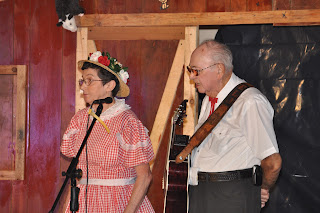
We had quite a few guest appearances that were well-portrayed by local musicians and singers. These included Makayla as Loretta Lynn, Lucas as Marty Robbins, Gary as Kenny Rogers, Zane as Hank Williams, Bethany as Dolly Parton, Rebekah as Patsy Montana, Dan S. as Johnny Cash, Dan F. as June Carter Cash, Lucas and Matthew as Roy Clark and Buck Owens, Terry H. as Grandpa Jones, Dennis as Willie Nelson, Larry as Julio Iglesias, and Terry L., Denise and Chelsea as the Soggy Bottom Boys. They not only sounded great, but they were all incredibly entertaining!


And of course, no Hee Haw show would be complete without Gloom, Despair & Agony or Gossip Girls!


We had many youngsters that participated in the show, helping with cornfield jokes, singing and other various necessities!


We had several bands, including the Voegele Sisters, Dual Generation, the Martin Family, and the Buries that performed songs for the audience.


We had Psst! She Wuz Gone complete with the kick-board fence! (We could have charged admission for everyone to try out the fence!)

And then you have those acts that just don't fit into any category! Take, for instance, Lucas and Heston's absolutely fantastic version of "Who's on First"? I would put it up against the very best!


We have so many people to thank, but probably top of the list would be Terry and Becky Hill, who worked tirelessly to build the entire set, which was no small feat! Our barn by itself was almost 10' tall by 16' wide. With the added sides, it spanned an awesome 32' long! Then we had the cornfield and the kick-board fence, too!

And of course we have to thank Bob Junge who provided me with all these great pictures! I don't have a photo of Bob, so my words will have to suffice!
The Bull Pen (where we held the show) was extra gracious, especially since we had to change venues less than a week before the show. They provided all the food and allowed us to use the entire week to erect the Hee Haw set. We would not have fit in the previous hall that we had intended on using.
Denise had a banner made for us to help us with advertising. We hung this at the entrance to the Village of New Athens so all could see.

We had more help with advertising from the New Athens News Brief, the Belleville News Democrat, the Bull Pen, and KDHX FM 88.1 radio station, and many other people who helped distribute posters and flyers.
We had a helpful setup crew and an even larger cleanup crew, all of whom are appreciated very much!
If you want to see more pictures, go on out to The Bluegrass Shack Facebook page. There are even more pictures posted there.
Here is the entire Hee Haw crew at the end of the show. We were all singing Amazing Grace, including the audience. I think we had the world's best audience!

We kicked everything off with 7-year Audrey playing and singing Rocky top. She's not only a cutie, she's very talented!

We were really blessed this year by professional Minnie Pearl impersonator, Marietta Bigham, and her "side kick" Ed Jeffs. They both did a fantastic job!
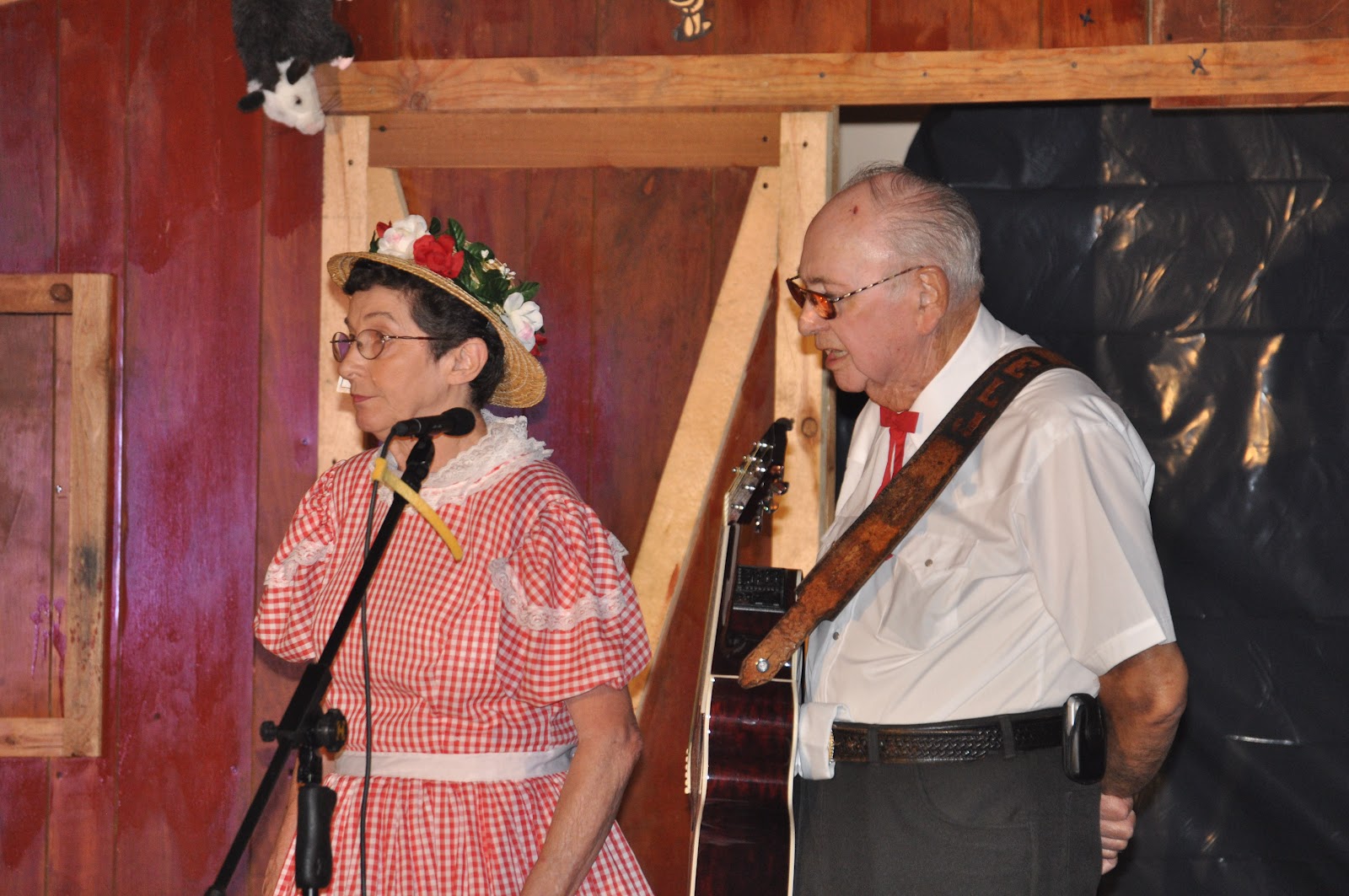
We had quite a few guest appearances that were well-portrayed by local musicians and singers. These included Makayla as Loretta Lynn, Lucas as Marty Robbins, Gary as Kenny Rogers, Zane as Hank Williams, Bethany as Dolly Parton, Rebekah as Patsy Montana, Dan S. as Johnny Cash, Dan F. as June Carter Cash, Lucas and Matthew as Roy Clark and Buck Owens, Terry H. as Grandpa Jones, Dennis as Willie Nelson, Larry as Julio Iglesias, and Terry L., Denise and Chelsea as the Soggy Bottom Boys. They not only sounded great, but they were all incredibly entertaining!


And of course, no Hee Haw show would be complete without Gloom, Despair & Agony or Gossip Girls!


We had many youngsters that participated in the show, helping with cornfield jokes, singing and other various necessities!


We had Psst! She Wuz Gone complete with the kick-board fence! (We could have charged admission for everyone to try out the fence!)

And then you have those acts that just don't fit into any category! Take, for instance, Lucas and Heston's absolutely fantastic version of "Who's on First"? I would put it up against the very best!


And how could you forget the real wedding that was hidden at the end of the show? We had several smaller skits that led up to the wedding, and it took folks a minute to realize this was a real wedding!


We have so many people to thank, but probably top of the list would be Terry and Becky Hill, who worked tirelessly to build the entire set, which was no small feat! Our barn by itself was almost 10' tall by 16' wide. With the added sides, it spanned an awesome 32' long! Then we had the cornfield and the kick-board fence, too!

And of course we have to thank Bob Junge who provided me with all these great pictures! I don't have a photo of Bob, so my words will have to suffice!
The Bull Pen (where we held the show) was extra gracious, especially since we had to change venues less than a week before the show. They provided all the food and allowed us to use the entire week to erect the Hee Haw set. We would not have fit in the previous hall that we had intended on using.
Denise had a banner made for us to help us with advertising. We hung this at the entrance to the Village of New Athens so all could see.

We had more help with advertising from the New Athens News Brief, the Belleville News Democrat, the Bull Pen, and KDHX FM 88.1 radio station, and many other people who helped distribute posters and flyers.
We had a helpful setup crew and an even larger cleanup crew, all of whom are appreciated very much!
If you want to see more pictures, go on out to The Bluegrass Shack Facebook page. There are even more pictures posted there.
Here is the entire Hee Haw crew at the end of the show. We were all singing Amazing Grace, including the audience. I think we had the world's best audience!

Friday, August 31, 2012
Jerseyville Victorian Festival Cancelled
Well, it's official. Hurricane Isaac's rain, which was so badly needed here, has caused the Jerseyville Victorian Festival to be cancelled for all three days. The Chris Talley Trio plays at this event every year, and we so look forward to seeing everyone! It's almost like a family reunion, and it's always so much fun to tour the mansion and revisit all the exhibits and the flea market. We even look forward to the antique malls in downtown Jerseyville and eating together with the reinactors Saturday evening. So to all you Jerseyville friends and acquaintances, we will miss you this year and we look forward to seeing you next year!
Sunday, August 19, 2012
Hee Haw Show & Jamboree!
Important Update for the Hee Haw Show! We have moved it to The Bull Pen so that we will have enough seating and parking available. The address is 101 N. Van Buren, which is the main road in New Athens. This location is only a couple of blocks from the previous location. When you turn at the stoplight from Hwy. 13 onto Van Buren, you will simply stay on Van Buren for about 5 blocks until you see The Bull Pen. You can turn on Kaskaskia and park in the back. Entrance through the back of the building where the HALL sign is. There will be signs posted.
The Hee Haw Show will be on Saturday, August 25, 2012. It is scheduled for 3:00 - 5:00 p.m., and is completely family-friendly entertainment. Don't miss seeing Johnny Cash, June Carter Cash, Minnie Pearl, Grandpa Jones, Hank Williams, Loretta Lynn, Dolly Parton, Patsy Montana and more!
There will be a break from 5:00 - 6:30 p.m. which will allow everyone to stretch their legs and grab something to eat. You can eat right at The Bull Pen, or you can choose from several other nearby restaurants if you prefer.
From 6:30 - 10:00 p.m., we will be having top notch bands from as far away as Nashville, TN and Wisconsin, and also many local favorites! Bands include The Worthing10s (Sparta, IL), Dual Generation (Fayetteville, IL), The Red Haired Boys (Marine, IL), The Burie Family (Wisconsin), The Chris Talley Trio (New Athens), and The Farm Hands Quartet (Nashville, TN).
One price pays for it all! Click on the flyer below to enlarge it. If you still need more information, call The Bluegrass Shack at 618-475-3678.

Subscribe to:
Comments (Atom)